Showing posts with label art. Show all posts

Wednesday, November 20, 2013

Drawing People


I've been drawing people all my life. Why do we draw people? I don't know, any more than I know why we make music, play games, or have pets. It seems to just be a part of human nature. Prehistoric men drew on the walls of caves, although from what's been left, they were apparently more interested in other animals than their own kind.

One of the better things about the school system here in Italy is that in elementary schools kids learn to draw, just as they learn to read and write and count. Drawing is perceived as another basic skill and means of communication. I don't recall much of that emphasis on drawing in the USA. As a kid, I went to church with my father every Sunday and spent the hour, or at least the parts where we weren't supposed to pray or sing hymns, drawing on the borders of the church bulletins. I tended to favor images of football players in action over Biblical figures.

After quietly accepting her abject failure in trying to teach me to play the piano, my mother went with the flow and sent me to an art school in my early teens. Although I was eager to paint, the school insisted that first we learn to draw, so I spent many afternoons learning how to render geometric shapes, from fruit to vases to classic busts. The discipline was good and there was even some satisfaction in it. However, drawing people (and other animals) is both more challenging and more fun. The subjects move, which creates much of the challenge, and they also change expression, which has a lot to do with the added satisfaction.

Many drawings of people are simply made up, based on observation and some acquired knowledge of anatomy, while others are remembered images. Both approaches can be enhanced by drawing people live. Shown here is the frontispiece of the book 90 Secondi all'inferno, with images drawn by Francesco Chiacchio, one of the best, among people I've met, at spontaneous drawings of remembered images.

Over a lifetime I've found a few ways to indulge my predilection for drawing people. Many years ago I visited my friend Ed Wallace in Germany, where he was studying in Tuebingen on a post-graduate fellowship. As I was assisting his research into the remarkable diversity of German beers, I occasionally pulled out my sketchbook to capture the likenesses of fellow researchers. Seeing the results, some on-lookers asked if they could have their images immortalized too. Presaging his triumphal career in the law, Ed jumped up and said of course they could but they would each have to buy a round of beers for our table. Thus, my unfortunately short-lived career as a semi-professional portraitist got started. Ed was the closest thing to an agent that I've ever had. Sadly, that ended when we both returned to our studies back in the US. Nevertheless, for a short time our research was accelerated, our spirits lifted, and my artistic self-confidence boosted.

It's not easy to find a way to carefully draw people, other than by asking them to pose for you, and you don't know most of the people you would really like to draw. Except for remarkable people like Francesco Chiacchio, drawing takes time. If you start to draw people you don't know, they will probably wonder why you're staring at them. They might be offended; they may go away; but in any case they will rarely stay in one position for long. When by-standers notice that you're drawing someone, they tend to gather around you, sometimes even offering compliments, but the anonymity and immediacy vanish and self-consciousness grows, making the drawing ever more difficult. Photography has largely replaced drawing and painting in the capture of human images and photographers, especially if unburdened by inhibitions, have few such problems. They can just poke a camera in a subject's face, click and be off., leaving the subject to wonder if that was a new incursion by the NSA or something else.

Snarling Dick
The trick is to find a captive subject.   Television is one place where the subject can't object or leave, but good TV directors work hard to see that camera angles keep changing, just to make the imagery less monotonous. Drawing faces quickly can lead to caricature and I've ventured into cartooning after years of drawing faces. Some faces lend themselves to caricature more readily than others. Dick Cheney's asymmetrical snarl was perfect. He seemed to be designed by a caricaturist and he inspired me to devote more time to that aspect of drawing. C-Span is the cartoonists dream. It features talking heads with little moving other than the mouths. Unfortunately , it's not available in Italy but I will be visiting the Rogue Nation this winter and C-Span should help to pass the time.

The most obvious chance to draw people live is in life drawing classes. I've done a good deal of this at times but living in a small rural community severely limits the opportunities, since such classes tend to be located in big cities and college towns. Years ago, professors in the collegiate centers seemed to be always spouting the obligatory apology that life drawing had nothing to do with sexiness or eroticism. It's true that when one is busy trying to understand the nuances of anatomy, perspective and foreshortening, and trying to capture all that on paper, the process is about as erotic as rendering the effect of light on a peach. Nevertheless, I still think the professors exaggerated a bit. After all, people have been paying to look at nude women through the ages, from Las Vegas to Timbuktu. While many drawings from life could just as well be of stones or of fruit, there are artists, such as Milo Manara, whose sketches are as sensuous and erotic as any images can be. If it's true “that beauty is in the eye of the beholder”, then Manara's eyes are a divine gift.

In drawing the nude, one tries to objectively capture the essence of the figure but I find myself either trying to idealize the form or else tending to emphasize the divergence from the ideal, depending on whether the model conjures images by Renoir or instead puts one in mind of Francis Bacon. The world being what it is today, I'm seeing people more and more resembling the images of George Grosz, from another very similar era.
Grosz nudes
Renoir nude
Francis Bacon nude


Drawing nudes is something like painting flowers. You try to capture the beauty of the bloom but if the flowers are too wilted, the emphasis shifts to pathos and decline. Portraiture tends to focus on how character and life experiences have molded the face, with clothes, backgrounds and other props filling out the narrative. Bodies tell their own stories too, from the dancers who often model at life classes, recognizable by their muscular legs, to others, too desperate for the modeling fee to even care that people see them in their current sad state.

Archie Shepp in SF 1966
I've probably spent as much time listening to jazz as I have drawing so it's unsurprising that at some point I would start sketching musicians as I watched them perform. You can't get better subjects to draw. You've paid to see and hear them and you can watch them as they work, sometimes up close. While they may object to photographers popping off flashes in their face, they can't object to someone looking at them too intensely, and they're too busy to notice. Better yet, they're not just sitting there; they are at work creating music and the effort, intensity and joy of making music can be seen as well as heard. There are problems in drawing at live music venues. Usually, performances are at night, and while the musicians are well lit, the audiences are not. Drawing in the dark is difficult. Maybe Ray Charles could have done it (he could do everything else in the dark) but for most of us, it's not worth the effort. Sitting up close to the stage sometimes resolves the problem but intimate outdoor afternoon concerts are as good as it gets. People often ask if I miss New York. In truth, not very much, but I do miss Caramoor, and the Charlie Parker Jazz Festival in Tompkins Square Park almost as much as Minerva's drawing studio in Soho, all great places to draw.
Amina Myers at Caramoor

Roy Haynes at Charlie Parker Festival
Musicians have become technically more proficient over the years I've been drawing them but there has been a significant decline in the visual appeal of their performances. Dizzy Gillespie's ceiling- aimed trumpet may have had acoustic motivations but I suspect it was as much a stylistic affectation as his beret and goatee. Miles Davis paid almost as much attention to his appearance (perhaps more in his late rock star years) as he did to his music. Thelonious Monk, whose spiritual home was light years away from Madison Avenue, was always impeccably turned out in a suit and tie. This served to heighten the contrast between his attire and his unconventional music and demeanor. The extreme exemplar of theatricality in jazz was the Modern Jazz Quartet, whose musical director, John Lewis, insisted that they perform in dinner jackets. Jazz musicians, especially black jazz musicians, had not been taken seriously by the (white) public and their dress code was a highly successful stratagem to change that. They created an unforgettable visual impression to go along with their splendid music.

Marsalis brothers
In subsequent decades musicians came to regard themselves as artists rather than entertainers and many felt that people should simply come to hear the important art that they were creating. That worked for a John Coltrane, whose intensity was riveting, but there was only one John Coltrane. In keeping with romantic and popular notions of eccentric artists, many musicians showed up looking like they'd they'd just crawled out of the cellar they were sleeping in. Sometimes they created fine music but more often than not, audiences at live music venues want to be entertained as well as being privileged to be in the presence of art. Times are changing again and many musicians, following the lead of the Marsalis brothers, seem to be rediscovering the importance of the visual aspect of their performances.


Botticelli

Raphael Madonna
Raphael woman
Italian 1400's
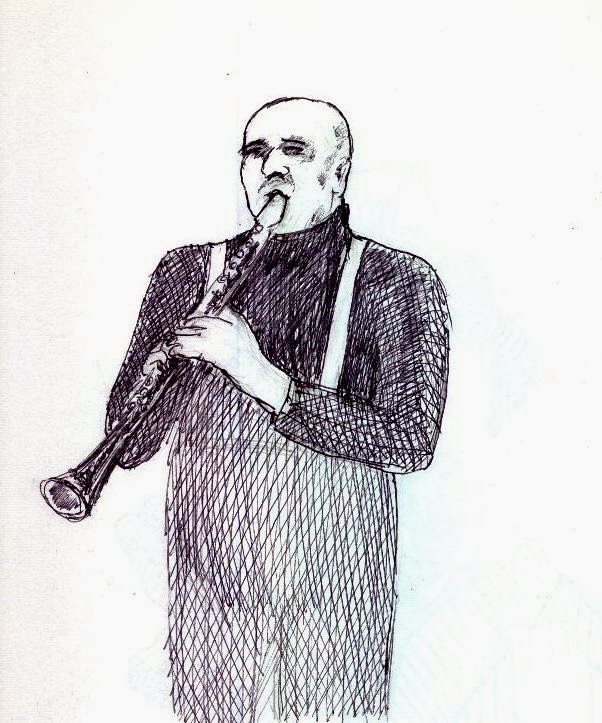
Fashions come and go. When I first came to Italy I was astounded by how good people looked. Young men seemed to resemble the images of their Tuscan ancestors painted in the 1400's and the women often replicated the sensual beauty found in the Rafael's madonnas. Italians like to be trendy. With the arrival of Yul Brynner on the big screen and Telly Savalas on the TV, they got accustomed to totally bald men, but when Michael Jordan came along, instantly all Italian men wanted to look like him. This led to a dubious experiment in baldness. If shaving one's head could make you look like Michael Jordan, why would it not also turn you into a world class athlete? (The butterfly tattooed on Serena Grande's thigh has stimulated a comparable effect among Italian women.) Among jazz musicians, Tony Scott was 
Tony Scott (hairless) at Mississippi Jazz Club
Tony Scott (with hair) at Iridium
ahead of the curve, both in the bald look and in the return to hair. (as well as in pioneering modern jazz on the clarinet) In recent years many more people have gone through chemotherapy than in the past, and I wish them all the best outcomes, including that their hair grows back more luxuriant than before, but if all the people in Italy who look like they're in the midst of chemotherapy actually have cancer, there's an epidemic that the press just isn't reporting.

Among the many impressions I've taken away from this year's inaugural Jazzit Fest is a sense that hair seems to be coming back. (I have nothing against drawing bald musicians but hair is one of the distinguishing traits of people, even if long hair and untrimmed beards can create an anonymity not so different from bald heads.)
Given the dismal economy that we're experiencing, it's understandable that a certain amount of scruffiness is also in evidence, but at least it's a more virile sort of scruffiness. I've even detected in a number of musicians (among the more than 400 in attendance) an increased self-awareness about how they appear. Whether the subjects are bald or hairy, well groomed, elegant or scruffy, I'll continue to seek opportunities to sketch musicians as they perform. UJ in Perugia, with most of its concerts located in the huge stadium, no longer offers many opportunities, but UJW in Orvieto at New Years, still features musicians up close. I'm especially hopeful about drawing while listening at the Jazzit Fest in Collescipoli next year. See you there. I might even draw you.

Wednesday, June 1, 2011

TV Reality


It's been a few years now since I worked in New York, and the Rome I worked in during the 70's has changed into another place. Living in an isolated Umbrian village of about 150 people, perhaps I'm out of touch with reality, i.e. the important things that go on in the world, although we do get to attend more funerals than most city dwellers do. Fortunately, we have the internet and Skype to keep in touch with people and happenings around the world. We also have satellite TV, which brings us another little window on the world. It's long been fashionable to disdain TV but, especially in the football off-season, I enjoy watching many of the shows, and have for years.

All my life, pundits on the right have complained of the liberal bias of the news media and Hollywood. They were right. After all, Edward R. Murrow was no Fascist sympathizer and one can fairly imagine his disdain for the Neo-Cons, were he around today. Unfortunately, he's not. For a time, I watched a large amount of cable TV news but increasingly, the cable channels seem more out of touch with reality than we are here in Acqualoreto.

Then there are the ”reality shows”. I haven't yet figured out why these shows are so named. Most seem to be elimination tournaments. Pseudo-celebrities pass their time trying to remain on a tropical island with other aspiring ”personalities”; other contestants aspire to work for Donald Trump, or be selected as a spouse, future model, fashion designer or bed partner. In others, people, hooked up to a lie detector, face embarrassing questions in front of their families, or attractive young people are challenged to put repulsive substances in their mouths and swallow. I suppose the common denominator, and plausible link to reality, is the competition of people willing to subject themselves to public humiliation for the prospect of winning money.

There are even too many comedy shows on television, but I'll have to pass on commenting on them since I've discovered that I'm allergic to laugh tracks, so for the most part, I'm left with the TV dramatic series.

Nearly all shows deal with crime, clearly the principal activity in the world. Murder is the favorite crime on TV, sometimes treated with a spectacular brutality, but more often with humor. The light hearted murder shows go back to before television, when crime magnets such as Sherlock Holmes and Mr. and Mrs. North had a merry time solving whodunits in books and movies. Over the years Ellery Queen, Hart to Hart and countless dozens of other TV series have mined this vein. One of my more recent favorites, Midsomer Murders, known in Italy as Inspector Barnaby, would appear to have depopulated all of southern England in its ten year run, but the characters and locales were delightful. My all-time favorite, Germany's Inspector Derrick, ran for twenty-four years, with just one writer, Herbert Reinecker, creating all 281 episodes. The series also furnished fascinating characters and locales around Munich. Horst Tappert, an ex-vaudeville song and dance man who played the Inspector, solved all those murders mostly by stalking the characters his intuition led him to suspect. The program featured little onscreen violence but a great deal of the darker side of human nature. In Italy, Terrence Hill, as Don Matteo, has been playing a parish priest in Gubbio for the past decade. The 144 episodes have, on average, included more than one homicide per show, which would appear to make scenic little Gubbio one of the most violent places on earth, with a murder rate exceeding that of the south of England, Detroit and Chicago combined.

The crime solvers have usually been private detectives or regular police but now and then a mystery writer gets into the act, as with Jessica Fletcher (Angela Lansbury) in Murder She Wrote, and currently Rick Castle (Nathan Fillion) in Castle. In addition to the FBI and the CIA, other specialized crime fighting units such as the NCIS, which may or may not exist in the real world, also see some action. Clearly, the world's preeminent profession, in the world of TV, is that of forensic medicine. While I do know one young man in that field, I never realized that he and his colleagues played such an important role in the war on crime. I believe it all started with Crossing Jordan, but they've spread to CSIs and NCISs all over the country, and now to Body of Proof. Even Inspector Barnaby and Castle went with the trend and got their own body disassemblers. Most of the corpse analyzer shows are similar, but one, CSI Miami, stands out. Not so much for its acting, writing or characters, but for its color. In my childhood, most color movies were in Technicolor, but if I remember correctly, Roy Rogers movies were shot in something called Trucolor, which featured everything in bright orange, with some contrasting aqua blue. These are the Miami Dolphins colors so it only seems right that a Miami crime show should replicate the old Trucolor hues, especially one starring the carrot-topped David Caruso.

In TV history, Dallas was the first show to take the continuing drama soap opera format to prime time. The format was upgraded by ER, which brought doctors to the forefront and good writers to the work behind the scenes. It also launched George Clooney's career. After years of ratings-boosting service, he faded into the sunset with his on-screen sweetheart Juliana Margulies. When ER finally ran out of juice, other medical shows like Grey's Anatomy and Private Practice followed, but their writers just couldn't seem to find much inspiration left in the clinical area, so those shows have triangulated between medicine, soap opera and soft-core porn. Other shows have taken a similar path but without the medicine. Sex and the City could be amusing; Desperate Housewives and Cougar Town a little less so, but then, there's no shortage of cheerfully lewd shows on SKY.

I've alluded to former complaints about the liberal bias in the media. Since the US lurched heavily to the right in recent decades, both the news shows and the entertainment shows have tried to accommodate the new public tastes. The past decade has brought us torture-as-entertainment shows including 24 and the various versions of NCIS. Although I've whole-heartedly embraced the lighter side of murder, I haven't yet adapted sufficiently to the new ethos to really enjoy 24.

More subtle right-wing inroads have come with Ayn Rand-inspired heroes such as Dr. House. Played brilliantly by Hugh Laurie, the British actor who was famous as the effete Bertie Wooster in the P.G. Wodehouse inspired series, Jeeves and Wooster, Dr. House is an egocentric, lame genius devoid of respect for rules, laws, feelings or etiquette. He perseveres to cure the most exotic illnesses heretofore unknown to man. Superman with a crutch! Despite the unreality of both the health care available and the excesses of the protagonist, the show usually manages to be entertaining.

Successful shows tend to be cloned and Lie To Me tries to build on the success of Dr. House. Another interesting British actor, Tim Roth as Dr Cal Lightman, hobbles around with the gait of a chimpanzee, though no explanation of this deformity is forthcoming, other than the unspoken desire to emulate Dr. House. His superhuman talent is to be able to tell if people are lying or telling the truth by looking at their faces, and this elite skill has earned him a huge cutting edge office and a bevy of doting beauties who put up with his crude ways and his House-like disavowal of law and manners. Among the adoring women is his partner, played by Kelli Williams, fresh from her role as the partner and wife of the creepy Bobby in The Practice. She risks being typecast as the abused partner. I prefer this show to Dr. House, mainly because the women are better looking, but the plots are also more imaginative. Too bad that Dr. Lightman's gorgeous ex-wife, Jennifer Beals, has moved to Chicago to be Police Commissioner on another new series, Chicago Code. The latter show seems to be yet another copycat, emulating Detroit 1-8-7, and it may turn out to be better than the one it copies. Both have a nice gritty feel to them and provide balanced accommodation to the prejudices of the left and right wing segments of the audience; racial equality on one hand and a healthy disregard for the niceties of the law on the other.

After crimefighters and doctors, the next most prominent TV profession would be lawyers. If the doctors and police tend to be the darlings of the right, we liberals tend to favor the lawyer shows. Series like The Defenders, The Practice, Boston Law and more recently, The Guardian and Raising the Bar (Avvocati a New York in Italy) have fairly regularly espoused a liberal democratic set of values. The Guardian, an otherwise interesting show, suffered by having a terminally unsympathetic character in the lead role, while Raising the Bar, which tempered its idealism with a strong infusion of cynicism, was a wonderful antidote to Fox News, and just too good to last. Now that George Clooney has come out of TV exile to sell coffee and Campari in Italy, his former ER love, Julianna Margulies has come back to star in The Good Wife as a lawyer married to a jailed Chicago politician. The shadowy side of the profession is on view here too but, again, the hearts of the protagonists are in the right place, even if other body parts tend to wander.

I love all these shows but my favorite of the genre had to be Judge John Deed. Half a century ago when I applied to law school, I didn't know where it would lead. It didn't lead anywhere, as I switched to architecture at the eleventh hour, but had I joined that oft-maligned profession, I couldn't have imagined a more appealing role model than the Porsche-driving, womanizing judge, played by Martin Shaw, who was always defending the underdogs from the corrupt powers of the establishment. This wonderfully produced, very British show, wasn't around for long, possibly because the suspension of disbelief was challenged by the odd circumstance that in every case that the judge presided over, the establishment villains were represented by his ex-wife, now married to the corrupt Minister of Justice, while the defense attorney for the put-upon victims always turned out to be his on-again, off-again girlfriend Jo Mills, played by the lovely Jenny Seagrove. She was often assisted by the Judge's law student daughter, which provided yet more conflicts of affection.

Many other professions have shown up as series protagonists. We've seen teachers, soldiers, undertakers, bartenders, priests, mafiosi and for six years, Patricia Arquette has appeared as a cuddly mom with supernatural powers in Medium, helping the DA to find serial killers. If the protagonists are interesting and/or appealing, and the writing is good, plausibility is no prerequisite for success.

I realize that salesmen, engineers, teachers and factory workers are also all underrepresented as key players, but what about architects? Not counting those home improvement shows like Extreme Makeover-Home Edition, how many series protagonists have been architects? One! Yes, there was one. Charles Bronson played Paul Kersey in the Death Wish movies and TV series. He stalked and killed dangerous street criminals before Rudy Giuliani even thought of becoming mayor of New York City. Despite the usual correctness of my political leanings, I was always fond of Charles Bronson in those movies, perhaps because of his no-nonsense manner, or maybe it was just the exciting novelty of seeing an architect as protagonist. But that was then and this is now. It's time for Death Wish XX. Street crime no longer is the dominating preoccupation it was in the 70's. The ten year-old fear factor of terrorism is wearing a little thin. Let's see a new crusading architect taking on the real villains of the day, bankrupting the banksters, and entrapping those corrupt mid-western governors. The Justice Department has given up on prosecuting our war criminals and the bought Supreme Court justices, so how about leaving it to a renegade architect on TV. If a medium is the last line of defense against serial killers, why can't an architect combat the oligarchs and their lackeys? So far, the urgent task of going after white collar criminals has been left mostly to Neal Caffery, a semi-reformed con-man, working with the FBI, on White Collar. There's a bit of a con-man in every successful architect, so why not have one join the battle. Just make him charismatic, with a beautiful girlfriend, or vice-versa, and keep the writing taut.

Friday, November 26, 2010

Giving Thanks

On 22 August 22nd, 1958, while bar hopping in lower Manhattan with a friend from college, I stopped in at the Five Spot Café on Cooper Square to hear Thelonious Monk.  I was already a jazz enthusiast but I’d never seen nor heard anything like Monk.  He played his own compositions featuring strange chords and infectious rhythms.  While the other members of his quartet played their solos, he’d get up and shuffle around in a little dance, seemingly oblivious to everything but the music.  I subsequently went to hear Monk in many other places such as The Jazz Gallery, Town Hall, Randall’s Island and even Central Park.  His records began to dominate my record collection.  When I was introduced to printmaking, my first woodcut was of Monk.  I've drawn and painted musicians for years but the most compelling image for me was always Monk.  When Michelangelo painted The Creation of Adam, he depicted God as a muscular man with a long gray beard.  Were I to undertake such a project, I could just as easily imagine God as a well-dressed, stocky black man in a strange hat dancing around a piano where he has just established the rhythm.

On a recent trip to England I was able to pick up a copy of a new biography, Thelonious Monk, The Life and Times of an American Original by Robin D. G. Kelley.  It’s a massive, scholarly dissertation, which took Mr. Kelley fourteen years to research and write.  Monk’s life is documented from his family origins in North Carolina through his death in 1982 in twenty-nine heavily footnoted chapters.  Just the acknowledgements of assistance in the book’s preparation take seven pages.

What emerges is a story of total dedication to music, with more than its share of tragedy, yet laced with humor.  Monk was a funny man and humor is there in much of his playing and comments.  He suffered from what has come to be known as bi-polar disorder, yet his playing was prolific, even if his recording was not.  Monk left school at sixteen to play in local clubs in his San Juan Hill neighborhood on Manhattan’s West Side.  Apart from touring the country for two years as pianist for a woman evangelist, he continued that pattern until he was hired as the house pianist at Minton’s Playhouse in Harlem at the start of 1941.  It was his first regular job and he was twenty-three.  There he learned from older musicians and taught the younger ones.  When bebop took off after the war, musicians he had played with, such as Dizzy Gillespie, Charlie Parker and Bud Powell, started becoming famous and had steady work, both at clubs and in recording studios.  That eluded Monk until the fifties.  Known and revered by the jazz community, Monk really only came to the wider public after getting a long engagement at the Five Spot in 1957.

Several themes permeate the book, beyond or behind the music: the women in his life; the effects of drugs and racism in the environment, and the irony that his long delayed success and critical acclaim never brought him the financial rewards that would have been expected.

Thelonious, who was named after his father, was supported, physically, morally and financially by three women in his life.  His mother Barbara took her three children to New York when Thelonious was four years old to get them out of the poisonous, racist atmosphere of North Carolina.  She raised him amidst considerable adversity and helped support him through many lean years.  He married Nellie Smith, the sister of his best friend, in 1948.  Nellie was his wife, closest companion and mother of his two children, personal manager and chief caregiver until his death in 1982.  However, through most of his career he had a patron and friend in Baroness Pannonica de Koenigswarter, a Rothschild heiress.  Monk met her in Paris on his first European tour in 1954.  She had married Baron Jules de Koenigswarter in 1935 and had two children before the war and three more after it.  Both Nica and her husband were decorated war heroes but following the war, the Baron became a career diplomat.  She grew bored with the diplomatic routine and they separated.  Her love of jazz took her to New York City where, to the chagrin of the management, her suite at the Stanhope Hotel became a second home to jazz musicians.  Charlie Parker died there, and two decades later, her house on the Palisades, overlooking mid-town Manhattan, became Monk’s home for the last nine years of his life.

Monk’s life and career spanned a period of extreme racial turmoil.  His mother took him out of the south, but San Juan Hill was not without its own racial tensions, and the young Thelonious had to fight his way to and from school.  His oft-cited moodiness may have been a symptom of his manic-depressive imbalance but the frequent reports of racially motivated killings contributed to it.  Monk played many benefit concerts for civil rights groups but he didn’t talk about it much.  He was scheduled for a Time Magazine cover story on Nov.28th, 1963. His image was replaced by that of President Johnson, following the November 22nd assassination of JFK.   The Time cover story would eventually appear three months later.

Drugs surrounded him.  He lost a nephew and countless friends and colleagues to drug overdoses.  At times, Monk was the only member of his quartet not addicted to heroin.  While he escaped addiction, his career was hindered by his arrest and thirty days of jail time in 1948 for possession of marijuana.  That cost him his cabaret card and the ability to play in NYC jazz clubs for a decade.

Time had written its cover story and Monk had a successful 12 city tour of Europe to introduce his first record for Columbia, Monk’s gross income reached $78,680.  However, after deducting travel and recording expenses, salaries, commissions and taxes, he was left with a net of $33,055.  Despite continuing to tour and play fairly regularly, that net had declined to $17,735 in 1966, not really a princely sum for a musician acclaimed around the world.  It got worse from there on.  His last recording date was in 1972.  In 1973 he withdrew to Nica’s house and only rarely played in public after that.  Two concerts at Carnegie Hall in 1976 were his last public performances.

Reading through the stories of a vast number of musicians whose lives were cut short by drugs brought up some personal thoughts.  In Gay Talese’s book on his Sicilian roots, Unto The Sons, the story of how the Sicilian Mafia facilitated the way for American troops to move through Sicily and up the Italian peninsula is illuminated.  It’s well known that the Mafia collaborated with the US Government to keep the Communist Party out of power in post-war Italy.  What is less well documented is the theory that some part of the government conspired with the Mafia to sedate the frustrated black masses in American cities through the supply of massive amounts of heroin.

People, and young people in particular, are incredibly influenced by peer pressure and by what’s going on around them.    When Monk’s peers in New York City were dying like flies from heroin, I was growing up in the nearby white suburbs.  The main commercial and peer pressures that we faced were to wear dirty white buck shoes, to smoke cigarettes, and to dance the Twist to the music of Chubby Checker.  I gave in to the first, but I found cigarette smoke so repulsive, and most pop music so irritating, that I never really succumbed to the others.  However, I was influenced by other people around me.  The father of my neighborhood friend smoked wonderfully aromatic cigars and my proximity to them started a lifelong habit.  Later a college friend took me by the Jack Daniel’s distillery in Lynchburg, Tennessee,  introducing me to another substance I’ve used and abused ever since.  Indeed, at this time every year, I look forward to a pumpkin pie laced with Jack Daniel’s Old No.7.  The influences we’re subjected to in our youth cast a lasting shadow on our lives.   Some are more fortunate than others.

This week many of us are following the pilgrims’ tradition of giving thanks to God for our survival, our food and shelter, and our family and friends.  In doing so, I am adding another personal thanks for being born in the right time and place to be exposed to one of the greatest artists of the twentieth century.

Tuesday, July 20, 2010

In A Sentimental Mood

In the course of attending Umbria Jazz for the past thirty-six years, I’ve developed the habit of sketching musicians as they perform, wherever that may be. This season, most of the sounds I’ve heard have emanated from the legions of grandchildren making pilgrimages to the family home, but on Friday, July 16th, I managed to slip out to Perugia for some music. Too late for the Roberta Gamberini concert, not inclined toward the over-elegant confines of the Hotel Brufani to hear Hilary Kole sing, and confused about the whereabouts of the Funk Off concert, I just had an ice cream and waited for the concert I’d come to Perugia for, that of Sonny Rollins.

What I saw is documented in the drawing here, and what most of us there really couldn’t see, appears in the photo. What I heard was something else again. Rollins started the concert with a long, raucous number that could have been the death rattle of some aging beast. Not an auspicious start, but as he played on, the power and the beauty of his music emerged. He is indeed a beast. He turns eighty on September 7th and while his walk gives away his age, his energy and creativity never abate. Backed by a four-man rhythm section of guitar, bass, drums and conga drum, Sonny Rollins played virtually non-stop, pausing only briefly for an occasional solo by guitarist Peter Bernstein. The concert featured standards from his repertoire of recent years, but some of the titles seemed particularly timely. He hit his stride with a thoroughly unsentimental version of Duke Ellington’s In A Sentimental Mood and went on to his calypso classic, Global Warming. Rollins was born in Harlem to parents from the Virgin Islands and his affinity for calypso songs runs deep.

Despite a harebrained US Senator erecting an igloo on the Washington Mall last winter to mock the concept of global warming, this has been the hottest first six months of the year since measurements were kept. The 32-35° temperatures (90-96 American degrees) in Perugia kept Corso Vannucci, normally carpeted with people at this time of the year, looking semi-deserted. Nevertheless, the huge Arena Santa Giuliana was ¾ full to hear the Saxophone Colossus, and while the hellish temperatures had abated somewhat with the sunset (the sun-baked concrete seats retained their heat), Sonny Rollins played without a break from 9:45 until midnight.

Sonny arrived on the jazz scene in the 40’s and 50’s, playing with Bird, Diz, Monk, Miles, Trane, Bags, Dexter, Stan and Bud. He’s survived all of them, as well as his wife of forty-six years, Lucille. She was also his manager, taking care of everything but the music until she died in 2004. He’s had to adjust, but he keeps on going, playing these Olympic–sized concerts. Five days before Perugia he played in Rotterdam and four days after the Perugia concert he was scheduled to play in Norway.

One of the last songs of the concert was “Why was I Born?” It’s a question that most of us ask at some point and one that Sonny Rollins has asked more than most. He’s found his answer. Sonny Rollins is here to play his music.

Tuesday, September 15, 2009

Herding Cats


Last week Todi held its annual Arte Festival. The Comune (county) of Todi has less than twenty thousand residents, half of whom live in the city, but in addition to its three major tourist-worthy churches and a large main piazza, which has served as the set for films such as “The Agony and the Ecstasy” and “Romanoff and Juliet”, the city has a magnificent 140 year old theater. The orchestra seats are surrounded by four tiers of boxes in the opera house style of the 1870’s. There is also a large 18th Century palazzo, the Palazzo del Vignola, which was restored following a tragic fire in 1982. The weeklong festival utilizes all these venues and while there are numerous concerts of various types of music, the emphasis is on theater, with the Teatro Comunale hosting a different play on each night of the festival.

On Friday I attended two concerts and several art exhibits with some neighbors I had recruited. A world-class noon concert at the theater, in which Ramberto Ciammarughi improvised for over an hour on movie music from Fats Waller to Leonard Bernstein and Disney to John Williams, Ennio Morricone and Nino Rota, kept the audience, which may have numbered as many as 45 people, totally enthralled. After lunch we headed for a large show of paintings by Roberto Banfi Rossi, in my humble opinion one of Italy’s finest living painters (I’ve written about him last February on this blog). The glossy 88 page program stated that the show was open in the morning and from 4 to 8 in the afternoon, and indeed the building was wide open at 4 PM when we went in. The subtleties of his glazes and incredible detail were not enhanced by the fact that nobody had turned on the lights. On the way out I asked a cheerful young woman downstairs in the huge Palazzo del Vignola about it and she said, “Oh, the show doesn’t start until 6 PM”. By 6 we were at a delightful concert of Neapolitan jazz by the Marco Zurzolo Quintet. Given that all 48 seats in the beautiful little Chiostro delle Lucrezie were filled, I suppose it could be regarded as a sell-out, as well as an undeniable artistic success. The Italians present may have numbered about 15, although I suspect none were local.

A couple of weeks earlier our tiny village of Acqualoreto had its own weeklong festa. I serve on the eleven-member committee which governs the Circolo di Acqualoreto and organizes the festa. My participation is essentially by default since, excluding children and women who no longer remember what month it is or where they’ve left their teeth, eleven more or less represents a quorum of the full time winter residents. What we really do well is food. The president of the Circolo procures and prepares most of the food himself, with precious help from some of the better cooks in the village. We had no trouble filling the tent for our opening night supper in the piazza with about 200 paying customers, well over our pre-established limit of 180. Younger people in town serve the food and all the diners seemed to love it. From there on our promotional skills seem to go downhill.

An old saying states that you can lead a horse to water but you can’t make it drink. My long experience with cats has taught me that you can offer them new types or food, or their regular favorites, but you can’t make them eat. Forget about teaching them to do anything else. I’ve always been amazed by circus people who manage to train lions and tigers to jump through burning hoops. Tigers are, after all, just big cats.

Our local people are easier to deal with than horses or cats. You can always get them to eat or drink. The jumping through hoops becomes more difficult. In the case of our festa, it consisted of participating in a bocce tournament and an art contest. I foolishly tried to organize a bocce tournament. While bocce is a game frequently played by older Italian men, our 16 team tournament was made up of children, some of whom re-enlisted after losing in the early matches, and recent èmigrès from Bermuda and Ireland. The hordes of Italians, who return to sit in the piazza for the month of August, continued to sit in the piazza. We set up an exhibit of the artworks done, mostly by their grandchildren, during the art contest, but none of them ventured the 100 meters to the show during its three day run. Several did buy their kid’s or grandkid’s drawings, unseen, at the auction. But then again, attendance and participation in these events by the members of the organizing committee matched that of the piazza sitters.

I suppose that there will be a festa next year, since the people all say they are happy that there’s a festa. They just don’t want to get involved, except of course, to eat. My own involvement has brought me little satisfaction, but on the positive side, every year brings me a greater understanding of how Mussolini came to be so popular in Italy, before he wasn’t.

Monday, February 23, 2009

Roberto Banfi Rossi and the Rembrandt Syndrome


Cribbed Klimt

Bogus Bacon Holy Bird
Borrowed Dalì Fires


Walking toward the scala mobile to go to the center of Perugia, my eye has been regularly drawn to a shop on Via Masi just across from the Sangallo Palace Hotel. The two stories of Lemmi Sartoria are devoted to selling beautiful silk ties, scarves, and accessories, but what caught my eye is a painting in the main display window. The painting is a surreal landscape of warriors, brides, markets, horses, mountains and architectural fragments, sometimes transparent and glowing with color. I've tried to photograph it but as you can see, the reflections of the the outdoors complicate the scene more than it is already.

Recently, while meandering around the center of Perugia, I came upon the Artemisia Gallery in Via Alessi. Its sleek well-lit interior contrasts cheerfully with some of the forlorn neighboring shops. Piero Dorazio paintings on the walls inside invited a closer look. Dorazio was perhaps Todi's best known painter, with an international reputation derived from his teaching in New York and his distinctive, colorful, minimalist op art style. I enjoy his work and consider his fame and success well-deserved. Still, op art and minimalist abstraction have never stirred deep enthusiasm in me. Proceeding further into the gallery past works of other excellent artists, I unexpectedly found myself in front of other images clearly from the same mystical imagination as the painting in the Lemmi shop. The painter is Roberto Banfi Rossi. He lives and works in Perugia and he should be better known.

I have painted for most of my life and my paintings have been influenced by artists that I've admired, from Dalì in my youth, through impressionists to George Grosz, Francis Bacon, Aubrey Beardsley, Emil Nolde, Gustav Klimt to Duccio di Siena and other medieval icon painters. I've tried to copy or borrow elements from all of them. The painter at the top of my personal Olympus has always been Rembrandt. Seeing reproductions of his work in school I wondered what the fuss was all about, but upon finally seeing his paintings "live", I finally understood, and I've been blown away by them ever since. Unlike my other favorites, rather than being an inspiration, Rembrandt's work stopped me cold and induced long pauses in my painting activity. I can imagine Miles Davis having a similar effect on on young trumpet players, just as surely as hearing John Coltrane got more tenor players to quit than to start mastering the tenor saxophone. When the mountain ahead looms too high, sometimes it's hard to take that first step forward.

I can only hope that some of the elements that come together in the work of Banfi Rossi, from the brilliant color to the historic memory, incisive brush strokes, luminous glazes and above all, the fertile imagination, can find their way into my own work. At the least, may Banfi Rossi not inflict the curse of the Rembrandt effect. If you have any money for art, go buy a Banfi Rossi. They're way underpriced.

Monday, February 9, 2009

Jazz and Painting

The largest art show ever held to celebrate the relationship between jazz and art ends its three-month run in Italy on February 15th. The Century of Jazz: art, cinema, music and photography from Picasso to Basquiat, is at MART, Museo di arte moderna e contemporanea di Trento e Roverato, in Roverato, near Lake Garda in the far north. The show, curated by Daniel Soutif, Gabriella Belli, and Joseph Ramoneda, will next move to the musèe du quai Branly in Paris for three months and then to the CCCN in Barcellona from July 21st to October 18th.

Many painters such as Dubuffet, Leger, Pollack, Grosz, Van Dongen, Picabia, Picasso, Otto Dix, Mattisse, Stuart Davis and Man Ray have been inspired by jazz and are represented in the show, not to mention record jackets and a number of films with jazz soundtracks. Several musicians, most notably Miles Davis, also painted, and have space in the show. Daniel Soutil, the organizer, says that in his opinion, Mondrian, whose work was transformed into the style we know him for by his exposure to jazz, best captured the essence of the music. What then, is the essence of jazz; spontaneity, rhythm, exuberance, emotion, aural decoration, composition, texture? Fortunately, many people see it in different ways, and many are represented in the show. My own feeling is that the work of Paul Klee, or even more, that of Miro, reflect the spirit of jazz better than does that of Mondrian, but I have no idea if either of them paid any attention to jazz. We do know that Jackson Pollack, whose work might suggest an affinity with Ornette Coleman or Albert Ayler, listened to Dixieland while painting. Many people painting jazz musicians or suggesting images of the music today, tend to favor expressionism, whether figurative or abstract. That approach often works well but it runs the risk of becoming a convention. My own paintings of jazz figures are really reinterpretations of old paintings, especially 14th century icons, rather than any attempt at a graphic interpretation of the music. The music moves us in different ways. The notable thing is that it has moved so many and continues to do so.