Showing posts with label urban issues. Show all posts

Sunday, December 18, 2011

UPS, Uncle Harry and the paramus of Todi

I wasn't the first in my family to go into architecture. My Uncle Harry had gone to drafting school and started working in an architect's office It didn't last long. Architectural work wasn't particularly remunerative even then but it might have afforded him the appearance of a more dignified calling, something which Uncle Harry couldn't care less about. He wanted to be outdoors. Harry was smarter than people gave him credit for. He thought that being confined to a drawing board under artificial light for forty hours a week was a bad deal with the devil, so he quit and got a job driving a truck for the United Parcel Service.

The Great Falls

That was in the days before Paramus NJ became the world's first and worst agglomeration of shopping centers. My mother, like most other suburban housewives in the area, would take a bus five miles to Paterson, with me in tow, to do her shopping. A few days later a UPS truck, often driven by Uncle Harry, would show up at the house with the clothes, furniture or whatever else my mother had purchased. I liked to go to Paterson. Not so much being dragged around the department stores but sometimes my grandfather would take me to see the firehouse he had worked in, showing me the hook and ladder with steering wheels at the front and the back and the shiny brass poles the firemen slid down from their upstairs sleeping quarters when the alarm sounded. Paterson also had the Great Falls, one of America's larger waterfalls, which just last month became a National Park, with Hinchcliff Stadium, the midget auto racing Mecca, just a stone's throw from the Falls. There were also Chinese restaurants where we could get Chow Mein to take home. There was even a street full of colorful gypsies. My parents warned us about them and when we went by car to Paterson, my father got through that one block of River Street as quickly as possible, making sure the car windows were all closed. That sense of urgency added to the gypsies' appeal but I was very much taken by the bright flaring skirts the women wore, so much more interesting than the dreary clothes of all the “normal people” around. The city had, and still has, a lot of interesting buildings, from the churches and institutional buildings reflecting the Dutch origins of many of the citizens, to the wonderful Victorian era brick industrial buildings. I can't say that as a kid I realized how rich that architecture was but I did sense that there was something there more interesting than in our manicured suburbs.


The Post Office
Everything has changed since then. Uncle Harry retired to Florida to spend his last several decades outdoors tending his grapefruit trees year round. The shopping centers of Paramus metastasized, killing off the department stores and smaller shops in Paterson, while turning housewives and their white collar husbands into part-time truck drivers. Even before the SUV (Shopping Utility Vehicle) had evolved, the monster American sedans and station wagons had the payload of about half a small UPS truck. The department stores of Paterson and Newark, as well as the shops of Hackensack, and even upscale Ridgewood, may have gone out of business, but UPS has only grown bigger. My positive feelings about UPS from Uncle Harry's time took a nosedive a few years ago when they kept leaving notes saying they'd unsuccessfully tried to deliver a package and then later that they had left my consignment of cigars with an unnamed neighbor who couldn't be found. This and their lack of pick-up points open on Saturdays led me to the firm conviction that, besides being more expensive, they are far less reliable than the US Postal Service, although Congress is doing its best to change that by eliminating the Postal Service. But back in the day, UPS provided a valuable service, which I'd like to see restored. In keeping with current economic trends, UPS and their competitors now seem to exist to service large corporations and they appear to be thriving.

A Pedestrian Entrance to Todi
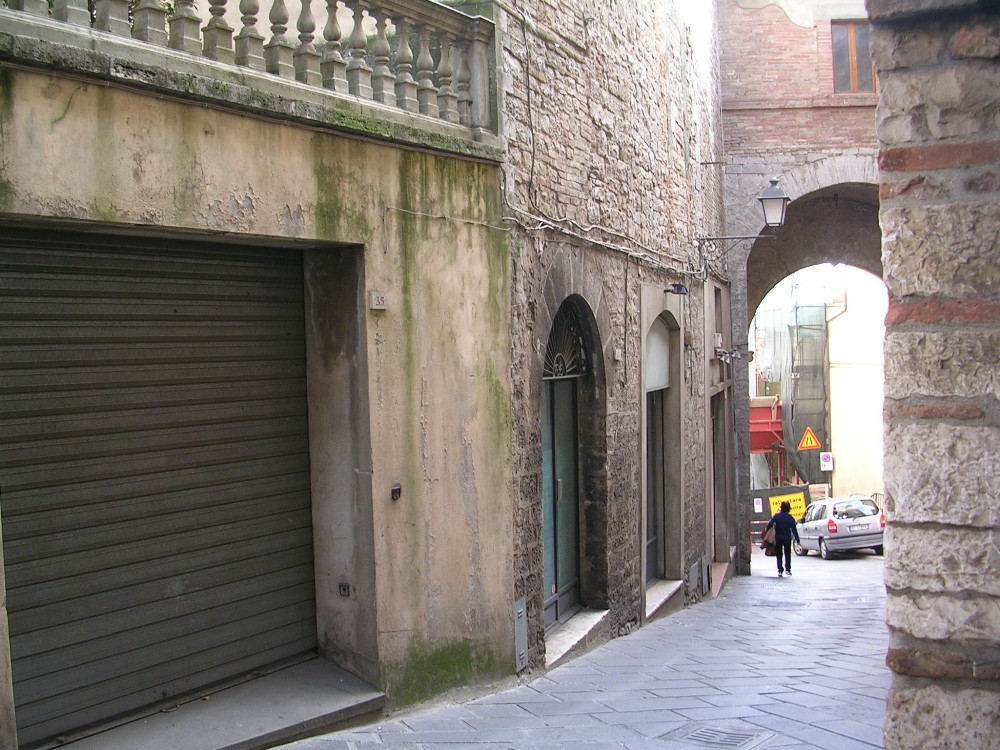
Much as Uncle Harry managed to emigrate to a place in the sun, I too have emigrated to sunnier climes in Italy. Paterson, my birthplace, fell victim to suburban sprawl and urban decay. Here in Umbria we're following the same path, albeit at a slower pace. Medieval towns, such as our neighboring Todi, are seeing the shops on their narrow streets go out of business, as new commercial centers crop up on surrounding plains. Convenience is God and every person, not just every family any more, has a car. Despite soaring gasoline prices (about US$8./US gallon by today's calculation), this is not likely to be reversed any time soon. The tourist traffic, which brings in much of the region's income, will probably diminish as the beautiful town centers go dark. People will continue to go to the supermarkets in their cars. It makes sense. But why must all the other “stuff” that we buy have to be sold in big box warehouse stores that deface the landscape? Smaller shops, accessible on foot in splendid surroundings, can display whatever we need, and unlike shopping on line, we can try on the clothes, handle the objects, and discuss the products with a knowledgeable salesperson. Must we all be truck drivers? For my part I'd rather see an Uncle Harry show up at my door with the stuff I'd seen and bought in an attractive and healthy city.

"Masterpieces On The Way" in Ponterio
Todi is much smaller than Paterson but it has a longer history and deeper culture than Paterson could even imagine. I don't remember anything about Paramus, other than the horrible traffic. I expect that future impressions of Ponterio, the town where the sprawling commercial development is taking place at the bottom of the Todi hill, will be similar. Ponterio is unlikely to be a must see in any guide books that will bring people to town. Paramus isn't so much a place as a condition, and sadly, it exists all over the world. I would even suggest to one of those forums that document additions to the lexicon that “paramus” be considered a term for a zone, neither urban or rural, populated by few human residents but covered by commercial and warehouse buildings, accessed by high speed highways transformed into multilane traffic jams and to which pedestrian access is either highly dangerous or completely forbidden.

My real concern is whether Todi will face the same fate as Paterson. I've heard that Paterson has shown modest signs of a revival. I hope so. But wouldn't it be great if our towns and cities could come back without first falling quite so far.

Wednesday, September 14, 2011

The Hospital is Dead, Long Live the Hospital

With the opening of the new Todi Hospital in Pantalla, eight kilometers to the north, Todi has finally entered the twentieth century. Remember, the one in which each significant bit of human interaction was bracketed by a trip in a car? Members of the medical professions are delighted with the new modern facilities and potential patients in the area, heretofore apprehensive about questions of sterility in the operating rooms of the old non-air-conditioned hospital, will be reassured by the tidy new building.

I may find myself there one day, just as I have been a patient in the old hospital. Thinking back to a painful 16 kilometer race to the emergency room, I can only hope that any future trip to the more distant facility will be under less urgent conditions. At the risk of compromising my journalistic objectivity, I must admit I was fond of the old hospital. Although we knew at least two people who unexpectedly failed to survive routine treatment at the hospital, the food was good and the staff friendly. While there for nearly a week, I was cheered up by the stream of visitors casually dropping by to say hello. Over the years, when we've known that somebody from our village, or a neighboring one, was in the hospital, we've gone in to see them when we happened to be in Todi. Times change and I suppose patients will just have to get used to the TV for company.

Italian hospitals provide free basic medical care and all the tests required but for routine functions, such as getting up to go to the bathroom, or help with eating or washing, patients either have family members with them, or they pay someone to provide such assistance. There's no sign that any new system of assistance will accompany the new out-of-town hospitals. Todi is only the latest of these in Umbria. New hospitals dot the landscape outside of Perugia, Orvieto, CittĂ  di Castello and Gualdo Tadino. Even in Rome, the newest hospital is out near the ring road, more easily accessible from the airport than from the city center.

With the possible exceptions of commemorative Presidential Libraries and lavish new sports stadiums, hospitals are the most costly buildings that we build today, mostly due to their technical requirements. It's certainly easier and cheaper to build a new facility on virgin land than to try to renovate an existing and functioning city hospital. For people running the health system, the decision to close the hospitals in Todi and Marsciano and replace them with a new hospital, officially named the Ospedale Media Valle del Tevere, about ten kilometers from each city, may have been a no-brainer, but was anyone involved in the decision who weighed the social costs and other on-going expenses? Clearly, not every doctor, nurse, technician, patient, relative, assistant and visitor lives in the town center, but many do, and most of the rest are scattered around town in a fairly small radius. That translates into an extra twenty kilometer trip each day for every person, in whatever capacity, at the new hospital. In terms Americans can understand, gasoline now costs about $8.50/gallon and is trending upward. Frequent bus service has been provided between town and hospital but those buses have their costs as well. Perhaps the extra transportation costs are low relative to the medical efficiencies involved. But what of Todi, the beautiful medieval hill town that brings people and money to the region in the first place? There is essentially one street in and one street out of the center for cars, with little parking available in the narrow streets. The one traffic lane of the main descending street, Corso Cavour, is shared with nervous pedestrians. Given the risks of being run over, people have ever less reason to walk on the Corso and it shows. Once you walk down the main street about 100 meters from the Piazza del Popolo, its name changes to Via Roma and the percentage of unoccupied shops rises alarmingly. The hospital is at the bottom of the street, at this point called Via Mattioti, just before the Porta Romana in the old peripheral wall of the town. It brought a constant flow of people of people into the area and shops, ranging from tavole calde and snack bars to housewares and clothing shops, thrived there for years. Now the dead zone will metastasize.

Urban blight is not the sort of disease that the health authorities are asked to deal with. Discussions about closing and replacing the hospital went on for more than a decade during which time someone should have realized what closing the hospital would do to the town. Where were the local, provincial and regional governments? To my knowledge there is still no solid plan for the future use of the old hospital. There is however a plan to deal with the lack of parking and access to the town center. My early guess is that the treatment will kill the patient. More about that in a future article.

Orvieto had a similar situation when its new hospital was built out of town. In fairness, construction there took about twenty-five years, after politicians managed to misplace the first batch of money that had been appropriated, the building was trashed by vandals, and the project was restarted, so there was ample time to plan. Furthermore the old hospital was adjacent to the fabulous Duomo and the mix of tourists and patients was beneficial to neither group. The ex-hospital has been transformed into a local center for university students from Rome, as well as from several US universities, bringing increased vitality and commerce to the town center.

I visited the new Todi Hospital to take photographs but hadn't planned to use the facility prior to writing this piece. Then my wife suddenly needed to have an X-ray, for which our doctor prescribed an immediate appointment and we drove straight to the Emergency Room entrance to be processed in. After being advised to drive around to the main entrance and proceed to radiology, we chose to walk, probably a bad choice, since although the hospital has many fine features, internal circulation isn't one of them. After finding an exit and walking around to the front, I left my wife to the radiologists and circled back to move the car to the vast main parking lot. Parking, like lunch, is never free and although there is no user charge at the moment, the extensive parking lots certainly added to the cost of the new facility. However, in this case, inasmuch as no one will ever arrive at this hospital on foot, I would propose that even more money be spent on the parking, enough to plant a few trees or even to provide covered walks to allow sickly visitors to traverse the blazing pavements without recourse to emergency treatment. A portion of the hospital facade is recessed at the ground floor level providing a bit of respite from the weather. Why couldn't this have been extended across the entire facade? They were starting from scratch after all, not making do with an old building.

I wish the new hospital all success. My own future may depend on it. A more immediate wish is that the Todi city fathers awake from their coma and start showing the town and its inhabitants a little more respect.

Friday, November 26, 2010

Giving Thanks

On 22 August 22nd, 1958, while bar hopping in lower Manhattan with a friend from college, I stopped in at the Five Spot CafĂ© on Cooper Square to hear Thelonious Monk.  I was already a jazz enthusiast but I’d never seen nor heard anything like Monk.  He played his own compositions featuring strange chords and infectious rhythms.  While the other members of his quartet played their solos, he’d get up and shuffle around in a little dance, seemingly oblivious to everything but the music.  I subsequently went to hear Monk in many other places such as The Jazz Gallery, Town Hall, Randall’s Island and even Central Park.  His records began to dominate my record collection.  When I was introduced to printmaking, my first woodcut was of Monk.  I've drawn and painted musicians for years but the most compelling image for me was always Monk.  When Michelangelo painted The Creation of Adam, he depicted God as a muscular man with a long gray beard.  Were I to undertake such a project, I could just as easily imagine God as a well-dressed, stocky black man in a strange hat dancing around a piano where he has just established the rhythm.

On a recent trip to England I was able to pick up a copy of a new biography, Thelonious Monk, The Life and Times of an American Original by Robin D. G. Kelley.  It’s a massive, scholarly dissertation, which took Mr. Kelley fourteen years to research and write.  Monk’s life is documented from his family origins in North Carolina through his death in 1982 in twenty-nine heavily footnoted chapters.  Just the acknowledgements of assistance in the book’s preparation take seven pages.

What emerges is a story of total dedication to music, with more than its share of tragedy, yet laced with humor.  Monk was a funny man and humor is there in much of his playing and comments.  He suffered from what has come to be known as bi-polar disorder, yet his playing was prolific, even if his recording was not.  Monk left school at sixteen to play in local clubs in his San Juan Hill neighborhood on Manhattan’s West Side.  Apart from touring the country for two years as pianist for a woman evangelist, he continued that pattern until he was hired as the house pianist at Minton’s Playhouse in Harlem at the start of 1941.  It was his first regular job and he was twenty-three.  There he learned from older musicians and taught the younger ones.  When bebop took off after the war, musicians he had played with, such as Dizzy Gillespie, Charlie Parker and Bud Powell, started becoming famous and had steady work, both at clubs and in recording studios.  That eluded Monk until the fifties.  Known and revered by the jazz community, Monk really only came to the wider public after getting a long engagement at the Five Spot in 1957.

Several themes permeate the book, beyond or behind the music: the women in his life; the effects of drugs and racism in the environment, and the irony that his long delayed success and critical acclaim never brought him the financial rewards that would have been expected.

Thelonious, who was named after his father, was supported, physically, morally and financially by three women in his life.  His mother Barbara took her three children to New York when Thelonious was four years old to get them out of the poisonous, racist atmosphere of North Carolina.  She raised him amidst considerable adversity and helped support him through many lean years.  He married Nellie Smith, the sister of his best friend, in 1948.  Nellie was his wife, closest companion and mother of his two children, personal manager and chief caregiver until his death in 1982.  However, through most of his career he had a patron and friend in Baroness Pannonica de Koenigswarter, a Rothschild heiress.  Monk met her in Paris on his first European tour in 1954.  She had married Baron Jules de Koenigswarter in 1935 and had two children before the war and three more after it.  Both Nica and her husband were decorated war heroes but following the war, the Baron became a career diplomat.  She grew bored with the diplomatic routine and they separated.  Her love of jazz took her to New York City where, to the chagrin of the management, her suite at the Stanhope Hotel became a second home to jazz musicians.  Charlie Parker died there, and two decades later, her house on the Palisades, overlooking mid-town Manhattan, became Monk’s home for the last nine years of his life.

Monk’s life and career spanned a period of extreme racial turmoil.  His mother took him out of the south, but San Juan Hill was not without its own racial tensions, and the young Thelonious had to fight his way to and from school.  His oft-cited moodiness may have been a symptom of his manic-depressive imbalance but the frequent reports of racially motivated killings contributed to it.  Monk played many benefit concerts for civil rights groups but he didn’t talk about it much.  He was scheduled for a Time Magazine cover story on Nov.28th, 1963. His image was replaced by that of President Johnson, following the November 22nd assassination of JFK.   The Time cover story would eventually appear three months later.

Drugs surrounded him.  He lost a nephew and countless friends and colleagues to drug overdoses.  At times, Monk was the only member of his quartet not addicted to heroin.  While he escaped addiction, his career was hindered by his arrest and thirty days of jail time in 1948 for possession of marijuana.  That cost him his cabaret card and the ability to play in NYC jazz clubs for a decade.

Time had written its cover story and Monk had a successful 12 city tour of Europe to introduce his first record for Columbia, Monk’s gross income reached $78,680.  However, after deducting travel and recording expenses, salaries, commissions and taxes, he was left with a net of $33,055.  Despite continuing to tour and play fairly regularly, that net had declined to $17,735 in 1966, not really a princely sum for a musician acclaimed around the world.  It got worse from there on.  His last recording date was in 1972.  In 1973 he withdrew to Nica’s house and only rarely played in public after that.  Two concerts at Carnegie Hall in 1976 were his last public performances.

Reading through the stories of a vast number of musicians whose lives were cut short by drugs brought up some personal thoughts.  In Gay Talese’s book on his Sicilian roots, Unto The Sons, the story of how the Sicilian Mafia facilitated the way for American troops to move through Sicily and up the Italian peninsula is illuminated.  It’s well known that the Mafia collaborated with the US Government to keep the Communist Party out of power in post-war Italy.  What is less well documented is the theory that some part of the government conspired with the Mafia to sedate the frustrated black masses in American cities through the supply of massive amounts of heroin.

People, and young people in particular, are incredibly influenced by peer pressure and by what’s going on around them.    When Monk’s peers in New York City were dying like flies from heroin, I was growing up in the nearby white suburbs.  The main commercial and peer pressures that we faced were to wear dirty white buck shoes, to smoke cigarettes, and to dance the Twist to the music of Chubby Checker.  I gave in to the first, but I found cigarette smoke so repulsive, and most pop music so irritating, that I never really succumbed to the others.  However, I was influenced by other people around me.  The father of my neighborhood friend smoked wonderfully aromatic cigars and my proximity to them started a lifelong habit.  Later a college friend took me by the Jack Daniel’s distillery in Lynchburg, Tennessee,  introducing me to another substance I’ve used and abused ever since.  Indeed, at this time every year, I look forward to a pumpkin pie laced with Jack Daniel’s Old No.7.  The influences we’re subjected to in our youth cast a lasting shadow on our lives.   Some are more fortunate than others.

This week many of us are following the pilgrims’ tradition of giving thanks to God for our survival, our food and shelter, and our family and friends.  In doing so, I am adding another personal thanks for being born in the right time and place to be exposed to one of the greatest artists of the twentieth century.

Tuesday, June 15, 2010

Destroying a Medieval Town


Medieval hill towns, typical of Umbria, but present in most of Italy, grew up as fortified castles on hilltops where both visibility and air quality were good and would-be invaders had an uphill battle. Their massive external walls enclosed and protected artisans and shopkeepers, as well as some of the people who worked the surrounding agricultural land. Little changed in this scenario for a millennium until the advent of the automobile. Still, throughout the twentieth century these old towns continued to provide compact urban centers of remarkable architectural richness, surrounded by unspoiled landscapes.

Indeed, Professor Richard Levine, who headed an overseas branch of the University of Kentucky School of Architecture, starting in 1983, described one such medieval town, our own nearby Todi, as the model sustainable city. The town fathers were thrilled by the good professor’s praise and went on to declare Todi to be the world’s most livable city. No doubt Prof. Levine only intended to identify the urban characteristics in evidence in Todi as qualities to be emulated elsewhere. In what would be an extreme case of the law of unintended consequences, foreigners flocked to Todi to buy up houses and apartments where they could spend two or three weeks a years reveling in this ideal environment. Every third shop in Todi was transformed into a real estate agency and very quickly existing houses were priced well beyond the means of young local people who needed homes. Despite a static local population, a great deal of building has taken place on the periphery of Todi since its fame spread.

The town government has done a reasonably good job (scroll down to “The Sienese Invasion” for a notable exception) of assuring that the new buildings are compact and the materials reasonably harmonious with the existing town. However, when people are compelled to move to new houses, they want those houses to have modern amenities, or more precisely, the basic modern amenity, easy access to a car, and the new housing has provided this access. Despite worldwide evidence that we’re facing energy shortages and that greater urban densities will be needed to sustain our environment and our standard of living, Todi is moving from a compact pedestrian-oriented town to one in which most local movement is by car. Todi’s main street is a narrow passage allowing one lane of downhill traffic and, in most places, one lane of parking. It doesn’t work very well for shoppers who come by car, and merchants complain that the city hasn’t done enough to provide parking. In reality, the city has done a great deal to improve access. In addition to frequent bus service to the center, a large pay parking lot has been built at the bottom of the hill with a funicular elevator leading to the center of town. Existing parking spaces in town have been divided into those reserved for residents and others where people can park and pay with time-stamped tickets from conveniently located machines. In a town so dense and hilly, there just isn’t a lot of space to put cars. The main piazza at the apex has a busy mix of commercial, governmental and cultural activity. Local institutions make a strong effort to promote fairs, concerts, theater, etc. in the town center. Nevertheless, shops along the main street have been closing for years, and once you get 150 meters down the hill from the piazza, the empty shops outnumber those still in business, at least until you approach the hospital near the bottom. More on that another time.

Much of Todi’s revenue these days derives from tourism. The beauty of its setting and its architecture are impressive attractions, but if its economic decline continues, its appeal to visitors will diminish, creating a sad downward spiral. Some of the recent changes were inevitable, others less so. The arrival of large supermarkets signaled the end of the small food shops in the center, just as has happened everywhere else in the world. Nevertheless, small shops depend on pedestrian traffic and it can’t all be tourists.

What’s to be done? Many people have tried to answer this but the decline continues. I don’t pretend to have all the answers, but I do believe more of a stick and carrot approach is required. The town has provided lots of carrots, such as subsidies to people opening shops in the town center, and the amazing variety of cultural promotions. I would propose taxing the owners of storefront properties on the main streets that remain vacant. The owners have to pay taxes on the rental income, an incentive to not rent, but not on the value of business potential. The community spends a fortune to keep the town viable, but by holding out for non-economically feasible rents, these owners are damaging the town by wasting a valuable community resource.

It’s also important that doctors, lawyers, notaries, dentists, accountants and design professionals keep their offices in the town center to insure an ample presence of pedestrians. Unlike supermarkets, these activities do not require a steady flow of bulk merchandise. Many doctors, etc. have already moved to the new residential districts where parking is hardly better, and where the flux of patients does nothing for the town. Whether by stick or by carrot, they should be encouraged to stay in (or move to) the center.

As local residents, what can we do? We can support the various government initiatives to promote the town. More practically, we can patronize businesses in the center, from barbers, lawyers, dentists and shoemakers, to bars and restaurants. Do your banking in town rather than at the strip mall. This violates the theology of the new religion of Convenience as God, but heresy has its own rewards. It may take more time to park one’s car and walk through Todi to a bank in the center than it does to stop at some roadside shack, but for those of us not under inflexible time constraints, the trip is well worth it.


Wednesday, February 17, 2010

Bi-polar Baschi


Wikipedia says bi-polar disorder is a condition in which people experience abnormally elevated and abnormally depressed states for a period of time in a way that interferes with functioning. Some of us have known people with this problem but here in Acqualoreto we’ve come up with a new variant, a bi-polar local government.

Our local government isn’t really local, since the village of Acqualoreto is only one of nine towns and villages in the Comune (Township) of Baschi. Despite having only 2650 residents, the Comune covers a huge area and our village is twenty-four kilometers from the seat of government in the town of Baschi. The population of Acqualoreto may reach 150 but it fluctuates wildly from winter to summer and many residents live in the countryside or along the roads leading in and out of the village. Less than thirty people currently reside within the remnants of the medieval castle that forms the core of the village. The street running around the circumference of the core is 200 meters long.

Last summer, during the manic phase of local activity, the cobblestone paving of the perimetral street was completed. It had been started a few years earlier in conjunction with the driving of dozens of huge piles to consolidate the hill, the laying of new sewers, and the burying of most overhead utility lines. At the same time, most of the five kilometer road down to the river was repaved and the fifteen year-old concrete retaining walls, which keep the town from sliding down the hill, were faced with local stone. That so much time, effort and money was expended on a shrinking medieval village is something I don’t expect my pragmatic brethren in the USA to understand, but I rejoice that there is a determination in Italy to preserve treasures that we’ve inherited from the past.

Psychologists suspect that Vincent Van Gogh suffered from bi-polar disorder. Most of us are grateful for his manic output and creativity but his life was plagued by self-doubt leading to madness and despair.

What passes for madness and despair in Baschi appears to reside in the Building Commission, which has shown signs of instability for decades, even as the other administrative functions of the Comune have grown steadily more responsive to the public’s needs over the past several administrations. Its task may not be easy since Italy has more laws than most other countries, laws that are frequently in conflict with each other. As long as I’ve been here, rules for building on agricultural land have been restrictive, with three hectares of land required to build a modest sized house. About a decade ago, the laws were made even more restrictive, although some concessions were made allowing larger additions to existing buildings. When the new regulations went into effect, new houses started popping up in the woods like mushrooms. Somehow, despite the restrictive regulations, some of these new houses even had auxiliary guest houses nearly as large as the main house, on plots that didn’t appear to be all that vast. Whether they’re stately or garish, whether or not they exceed their allotted size or violate parts of the Building Code, nobody complains here about the new houses, or any other project for that matter, on the sound principle that everyone’s property is in violation of some regulation or other, and no one wants to be responsible for the irreversible unleashing of inflexible compliance powers.

The big wave of building subsided but it was only a lull before the depressive state returned, bringing strange projects in its wake. An abandoned house in the old village center has been allowed to disintegrate, leaking water into at least three adjacent houses, making them unsalable at best, uninhabitable at worst. Other than briefly closing the perimetral street to protect passers-by from falling roof components, the Comune has done nothing. Nearby, one owner did a nice job of renovating what had been the ugliest house in the old core. It had been abandoned for decades and now looks much better, except that the stucco walls are painted a bright white, in clear violation of local building rules. Outside the village, on the most beautiful building site on this precious protected landscape, a huge three-story stone bunker emerged from traces of an ancient foundation, all under the guise of renovation of an existing building. A nearly invisible remnant of a doorway with the outline of a tiny window above it led the archeologically expert designer/geometra to convince the Building Commission that this had been a two story building. The unfinished basement walls and windows, which were required to be enclosed by areaways and covered with soil, remain clearly in view from the village, below the elaborate stone walls above. The visual effect could be described as chaos and decadence but perhaps that’s allowing too much subjectivity to creep in.

Our general store/bar went out of business about five years ago when the owner died. Now the ground floor of the building is being divided up into two mini-apartments, one of which has a main room with no window. It gets light from a glass entrance door facing directly onto the street, an interpretation of the Building Code which could be seen as extremely creative, although more objective analysis would suggest it to be the product of a severely depressed, dysfunctional mind.

More recently, one neighbor built a simple but handsome and well-constructed stone guesthouse near his larger old farmhouse. The houses sit on a remote hill facing the village from a distance of about two kilometers and they blend nicely into the landscape. At the far end of the new house a balcony was built outside the bedroom on the upper floor. In keeping with the rest of the house, the detailing and workmanship were excellent. Apparently the balcony was not shown on the plans submitted to the Comune for approval. The geometra who drew up the plans either said, or was told by the authorities, that an upper floor balcony had to have an exterior stair to the ground to look like farmhouses did in the days when the ground floors were occupied by animals.

A few months after the house was completed, the Comune had its ultimate Van Gogh moment. The authorities, in the form of a Forest Ranger of all things, intervened and directed that the balcony, like Van Gogh’s ear, be immediately cut off. Bi-polar disorder can often be controlled through medication, but how does one medicate a comune, and can you get rid of the symptoms of depression without also halting all that good manic activity?

Monday, July 13, 2009

Paramus, Umbria

Being born and growing up within five miles of the intersection of Route 4 and Route 17 in Paramus, New Jersey has conditioned my whole life. Route 4 connected Bergen County to the George Washington Bridge and Route 17 was a major highway, which carried thousands of New Yorkers to the Catskills on weekends throughout the summer. While other towns had severe residential zoning and restrictions on commercial development, Paramus was a free for all. Both of these four-lane highways came to be lined with stores of all kinds and from the 50’s until the 70’s shopping centers grew like cancer along both, rendering them useless for travel other than from one shopping center to another. Alternate highways, such as Route 80 and the Garden State Parkway were built at great expense to take traffic from the increasingly clogged older roads. This process was going on throughout the United States but I believe Paramus was the leader, the first and worst in the development of the suburban sprawl model. With the growth of the Bergen Mall and the enormous Garden State Plaza, the nearby downtown shopping areas went into irreversible decline. Hackensack, the county seat, was seriously impoverished, but the larger and once bustling city of Paterson, established by Alexander Hamilton to be the major industrial city of the east coast, simply was transformed into a large depressed ghetto. It took years but the wealthy neighboring town of Ridgewood eventually lost all its fashionable shops, replaced by a tidal wave of new restaurants serving the increasingly rich population of nobody’s ever home families.

How did all this condition my life? Well, Paramus was one more element that made me want to get as far away as possible, for example to a city or village where every movement is not necessarily by car. I’ve lived in Italy since the early 1970’s so I thought I had escaped, but one should never underestimate the power of progress.

Perugia sits on a big hill with the Tiber Valley passing below it to the east. One of Umbria’s main north-south highways, E45, passes through this valley connecting Terni and Rome to the south with Cesena and other cities to the north. The A1 autostrada is half an hour to the west and , except for some coastal roads, most north-sout traffic in Italy is on A1 or E45

Sometime following WWII, a Jewish philanthropist owned a large parcel of land in Collestrada adjacent to the path of the highway. He wanted to set up a summer camp for poor children on the land. Most Italians in such circumstances would donate their resources to a charity run by the Church, but being Jewish, he decided to entrust the land to the Comune of Perugia to be used as the site for the desired facilities. Alas, the city or provincial fathers knew better. They decided that the land could be put to better use by putting a big shopping center on it. There was some resistance but when large commercial interests are at stake, resistance has a way of being overcome.

Some scandals did come out of the construction of the center, built around a IperCoop market, with one of the developers doing some jail time, but they seemed to concern payoffs in the construction process rather than the misappropriation of the land.

The commercial center is less ugly than most and the COOP ipermarket is one of the best places to shop in the Perugia area. The Italians apparently learned something, a little at least, from Paramus. E45 is a limited access highway so there is no direct entry to any of the big stores that now line the road. Nevertheless, on major shopping days, traffic running up and down Italy on E45 is totally blocked near the Collestrada exits and there is no alternate route. The point of blockage is just a kilometer or two before the turnoff for the rapidly expanding Perugia airport, so if you’re flying out of Perugia it’s wise to check if your departure date is on a big shopping day or not. For shoppers, the whole idea of monster shopping centers is a leisurely wandering and choosing from the glut of stuff, so the delays are a minor inconvenience. For the long distance travelers, both private and commercial, it’s one more unwelcome incitement to road rage. As for those poor children, well, they never carried much weight in the deliberations over what to do with the land donated to their welfare.