Showing posts with label architecture. Show all posts

Tuesday, June 15, 2010

Destroying a Medieval Town


Medieval hill towns, typical of Umbria, but present in most of Italy, grew up as fortified castles on hilltops where both visibility and air quality were good and would-be invaders had an uphill battle. Their massive external walls enclosed and protected artisans and shopkeepers, as well as some of the people who worked the surrounding agricultural land. Little changed in this scenario for a millennium until the advent of the automobile. Still, throughout the twentieth century these old towns continued to provide compact urban centers of remarkable architectural richness, surrounded by unspoiled landscapes.

Indeed, Professor Richard Levine, who headed an overseas branch of the University of Kentucky School of Architecture, starting in 1983, described one such medieval town, our own nearby Todi, as the model sustainable city. The town fathers were thrilled by the good professor’s praise and went on to declare Todi to be the world’s most livable city. No doubt Prof. Levine only intended to identify the urban characteristics in evidence in Todi as qualities to be emulated elsewhere. In what would be an extreme case of the law of unintended consequences, foreigners flocked to Todi to buy up houses and apartments where they could spend two or three weeks a years reveling in this ideal environment. Every third shop in Todi was transformed into a real estate agency and very quickly existing houses were priced well beyond the means of young local people who needed homes. Despite a static local population, a great deal of building has taken place on the periphery of Todi since its fame spread.

The town government has done a reasonably good job (scroll down to “The Sienese Invasion” for a notable exception) of assuring that the new buildings are compact and the materials reasonably harmonious with the existing town. However, when people are compelled to move to new houses, they want those houses to have modern amenities, or more precisely, the basic modern amenity, easy access to a car, and the new housing has provided this access. Despite worldwide evidence that we’re facing energy shortages and that greater urban densities will be needed to sustain our environment and our standard of living, Todi is moving from a compact pedestrian-oriented town to one in which most local movement is by car. Todi’s main street is a narrow passage allowing one lane of downhill traffic and, in most places, one lane of parking. It doesn’t work very well for shoppers who come by car, and merchants complain that the city hasn’t done enough to provide parking. In reality, the city has done a great deal to improve access. In addition to frequent bus service to the center, a large pay parking lot has been built at the bottom of the hill with a funicular elevator leading to the center of town. Existing parking spaces in town have been divided into those reserved for residents and others where people can park and pay with time-stamped tickets from conveniently located machines. In a town so dense and hilly, there just isn’t a lot of space to put cars. The main piazza at the apex has a busy mix of commercial, governmental and cultural activity. Local institutions make a strong effort to promote fairs, concerts, theater, etc. in the town center. Nevertheless, shops along the main street have been closing for years, and once you get 150 meters down the hill from the piazza, the empty shops outnumber those still in business, at least until you approach the hospital near the bottom. More on that another time.

Much of Todi’s revenue these days derives from tourism. The beauty of its setting and its architecture are impressive attractions, but if its economic decline continues, its appeal to visitors will diminish, creating a sad downward spiral. Some of the recent changes were inevitable, others less so. The arrival of large supermarkets signaled the end of the small food shops in the center, just as has happened everywhere else in the world. Nevertheless, small shops depend on pedestrian traffic and it can’t all be tourists.

What’s to be done? Many people have tried to answer this but the decline continues. I don’t pretend to have all the answers, but I do believe more of a stick and carrot approach is required. The town has provided lots of carrots, such as subsidies to people opening shops in the town center, and the amazing variety of cultural promotions. I would propose taxing the owners of storefront properties on the main streets that remain vacant. The owners have to pay taxes on the rental income, an incentive to not rent, but not on the value of business potential. The community spends a fortune to keep the town viable, but by holding out for non-economically feasible rents, these owners are damaging the town by wasting a valuable community resource.

It’s also important that doctors, lawyers, notaries, dentists, accountants and design professionals keep their offices in the town center to insure an ample presence of pedestrians. Unlike supermarkets, these activities do not require a steady flow of bulk merchandise. Many doctors, etc. have already moved to the new residential districts where parking is hardly better, and where the flux of patients does nothing for the town. Whether by stick or by carrot, they should be encouraged to stay in (or move to) the center.

As local residents, what can we do? We can support the various government initiatives to promote the town. More practically, we can patronize businesses in the center, from barbers, lawyers, dentists and shoemakers, to bars and restaurants. Do your banking in town rather than at the strip mall. This violates the theology of the new religion of Convenience as God, but heresy has its own rewards. It may take more time to park one’s car and walk through Todi to a bank in the center than it does to stop at some roadside shack, but for those of us not under inflexible time constraints, the trip is well worth it.


Wednesday, February 17, 2010

Bi-polar Baschi


Wikipedia says bi-polar disorder is a condition in which people experience abnormally elevated and abnormally depressed states for a period of time in a way that interferes with functioning. Some of us have known people with this problem but here in Acqualoreto we’ve come up with a new variant, a bi-polar local government.

Our local government isn’t really local, since the village of Acqualoreto is only one of nine towns and villages in the Comune (Township) of Baschi. Despite having only 2650 residents, the Comune covers a huge area and our village is twenty-four kilometers from the seat of government in the town of Baschi. The population of Acqualoreto may reach 150 but it fluctuates wildly from winter to summer and many residents live in the countryside or along the roads leading in and out of the village. Less than thirty people currently reside within the remnants of the medieval castle that forms the core of the village. The street running around the circumference of the core is 200 meters long.

Last summer, during the manic phase of local activity, the cobblestone paving of the perimetral street was completed. It had been started a few years earlier in conjunction with the driving of dozens of huge piles to consolidate the hill, the laying of new sewers, and the burying of most overhead utility lines. At the same time, most of the five kilometer road down to the river was repaved and the fifteen year-old concrete retaining walls, which keep the town from sliding down the hill, were faced with local stone. That so much time, effort and money was expended on a shrinking medieval village is something I don’t expect my pragmatic brethren in the USA to understand, but I rejoice that there is a determination in Italy to preserve treasures that we’ve inherited from the past.

Psychologists suspect that Vincent Van Gogh suffered from bi-polar disorder. Most of us are grateful for his manic output and creativity but his life was plagued by self-doubt leading to madness and despair.

What passes for madness and despair in Baschi appears to reside in the Building Commission, which has shown signs of instability for decades, even as the other administrative functions of the Comune have grown steadily more responsive to the public’s needs over the past several administrations. Its task may not be easy since Italy has more laws than most other countries, laws that are frequently in conflict with each other. As long as I’ve been here, rules for building on agricultural land have been restrictive, with three hectares of land required to build a modest sized house. About a decade ago, the laws were made even more restrictive, although some concessions were made allowing larger additions to existing buildings. When the new regulations went into effect, new houses started popping up in the woods like mushrooms. Somehow, despite the restrictive regulations, some of these new houses even had auxiliary guest houses nearly as large as the main house, on plots that didn’t appear to be all that vast. Whether they’re stately or garish, whether or not they exceed their allotted size or violate parts of the Building Code, nobody complains here about the new houses, or any other project for that matter, on the sound principle that everyone’s property is in violation of some regulation or other, and no one wants to be responsible for the irreversible unleashing of inflexible compliance powers.

The big wave of building subsided but it was only a lull before the depressive state returned, bringing strange projects in its wake. An abandoned house in the old village center has been allowed to disintegrate, leaking water into at least three adjacent houses, making them unsalable at best, uninhabitable at worst. Other than briefly closing the perimetral street to protect passers-by from falling roof components, the Comune has done nothing. Nearby, one owner did a nice job of renovating what had been the ugliest house in the old core. It had been abandoned for decades and now looks much better, except that the stucco walls are painted a bright white, in clear violation of local building rules. Outside the village, on the most beautiful building site on this precious protected landscape, a huge three-story stone bunker emerged from traces of an ancient foundation, all under the guise of renovation of an existing building. A nearly invisible remnant of a doorway with the outline of a tiny window above it led the archeologically expert designer/geometra to convince the Building Commission that this had been a two story building. The unfinished basement walls and windows, which were required to be enclosed by areaways and covered with soil, remain clearly in view from the village, below the elaborate stone walls above. The visual effect could be described as chaos and decadence but perhaps that’s allowing too much subjectivity to creep in.

Our general store/bar went out of business about five years ago when the owner died. Now the ground floor of the building is being divided up into two mini-apartments, one of which has a main room with no window. It gets light from a glass entrance door facing directly onto the street, an interpretation of the Building Code which could be seen as extremely creative, although more objective analysis would suggest it to be the product of a severely depressed, dysfunctional mind.

More recently, one neighbor built a simple but handsome and well-constructed stone guesthouse near his larger old farmhouse. The houses sit on a remote hill facing the village from a distance of about two kilometers and they blend nicely into the landscape. At the far end of the new house a balcony was built outside the bedroom on the upper floor. In keeping with the rest of the house, the detailing and workmanship were excellent. Apparently the balcony was not shown on the plans submitted to the Comune for approval. The geometra who drew up the plans either said, or was told by the authorities, that an upper floor balcony had to have an exterior stair to the ground to look like farmhouses did in the days when the ground floors were occupied by animals.

A few months after the house was completed, the Comune had its ultimate Van Gogh moment. The authorities, in the form of a Forest Ranger of all things, intervened and directed that the balcony, like Van Gogh’s ear, be immediately cut off. Bi-polar disorder can often be controlled through medication, but how does one medicate a comune, and can you get rid of the symptoms of depression without also halting all that good manic activity?

Thursday, June 18, 2009

The Sienese Invasion


Years ago, when visiting Umbria for the first time, my brother exclaimed: “My God, what wretched lives these people must have lived!”. This was in response to his first sight of the once gated portals and crenellated towers enclosing Todi, an experience that more commonly evokes comments such as “How lovely” from the bewitched tourists.

He was right of course. Life in medieval Umbria was no doubt short, hard and cruel. City-states frequently attacked neighboring towns and those walls and portals were not there for decorative purposes, no matter how decorated they were, nor how attractive they may appear to us today. What escaped him was the irony of the fact that while the portals of Todi are no longer closed, those of his own gated community are not only closed, but also defended by armed guards around the clock.

The most popular anecdote routinely told to Todi visitors is about the façade of the Church of San Fortunato. It has remained unfinished since the late 1400’s when people came from Orvieto to put out the eyes of the architect, so that he couldn’t create a rival for the façade of their own splendid cathedral.

In the future, our children may have a sequel. While I’m unaware of any further threat from Orvieto, we may be under some sort of stealth attack from Siena. Why Siena? I can only guess. Tuscany received the first big influx of foreign settler money and after everything there has become overpriced and overcrowded, some of the surplus foreign money started flowing to Umbria. Just as Orvieto had its own great cathedral, the Sienese have had plenty foreign investment but perhaps, like the old Orvietani, they don’t want to see a neighboring territory share the wealth and the glory.

The evidence? In the past several years, an architect from Siena, Andrea Milani, has secured three major commissions in the Todi area: the Parco Fluviale in Ponte Rio; a new office building on the site of the old olive oil consortium in Todi; and the renovation of the old convent of San Bartolomeo in Ceccanibbi. This isn’t necessarily unusual, or evidence of an attack, given that once architects get their foot in a regional door, they always try to branch out with multiple local commissions. While I’ve studied neither the first nor the last of these projects in any great detail, and I continue to hope for the best, the new office/retail building (ex-elaiopolio tuderte), just across the street from the medieval wall, has raised the specter of a regional invasion. While there have been no news of bombings of Umbrian wineries, this assault seems more in the spirit and methodology of the Greek invasion of Troy. Rather than a crude attack on the city, say by sending 50 progress-crazed geometre to plan 100 new industrial warehouses on the farmland below Todi, the attack has been brought by a smooth talking architect speaking in glowing terms (on his website) of the opportunity to bring contemporary architecture to a site of particular historic/environmental interest. The florid descriptions of the rich materials to be used and their dialog with the antique walls are too poetic for me to adequately translate. If you can read Italian, I suggest you read it for yourself here under progetti, nuove architetture, No.2.

The emerging building is not quite complete, although a supermarket has opened in the basement this week. The building’s huge glazed areas are framed in gleaming, untinted aluminum and the walls, which were a dazzling white, smooth concrete, have been darkened down somewhat in recent weeks. Perhaps it really is possible to make a silk purse from a sow’s ear although at this writing, the silk purse has yet to emerge, and there is no trace of the delicately perforated weathered copper sheathing specified to cover the left side of the building. The deeply striated stucco surface of the right side of the building still seems as smooth as a plain sheet of paper.

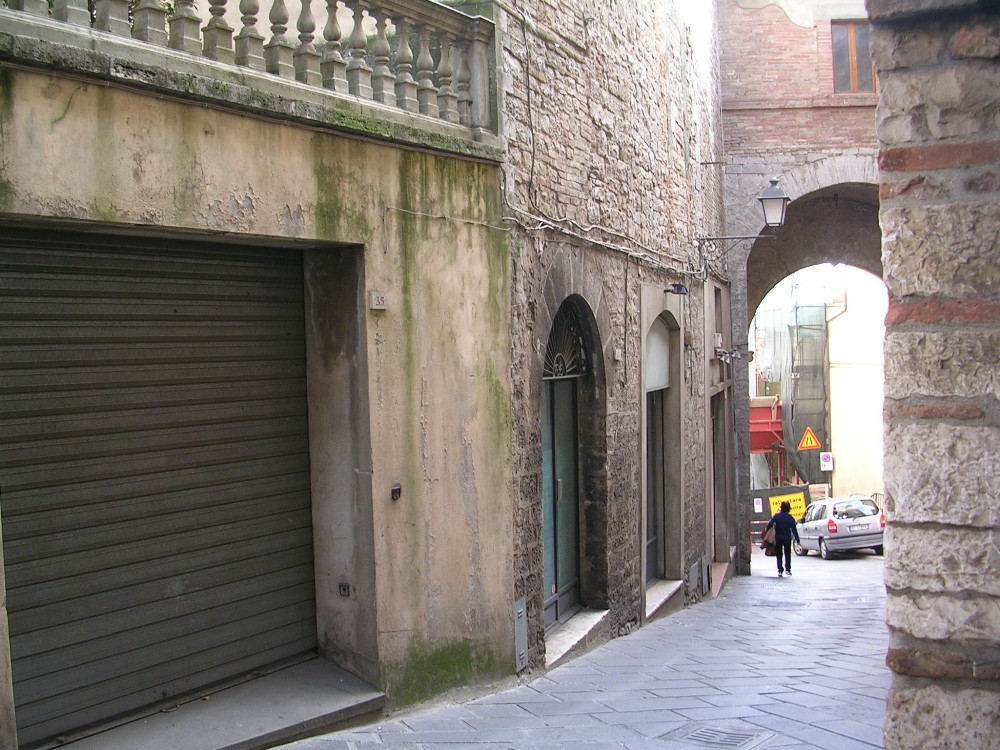
There is some irony in the fact that the building houses a supermarket. We used to shop in a tiny supermarket just across the street in what we referred to as the hole in the wall, literally a simple unmarked door in the ancient wall of the town (first door on the right in the picture). That shop was driven out of business by the opening of four new and larger supermarkets in the Todi area.

Questions remain. What’s behind it? Has the ufficio tecnico of Todi been infiltrated by hostile Sienese? Have an architect’s noble intentions once again been subverted by a budget-cutting owner? Was the project submitted for approval as per description on the web site, or as built? If as described, what is the city doing about it? I visited the technical office hoping for answers. The clerks there told me that the director of the office who had approved the project no longer held that position. I don’t know if he was a political appointee who had been replaced after the recent change of administration, or was simply a disgruntled retiring employee taking revenge on the city for imagined slights. Those in the office conceded that there had been a flood of protests and they couldn’t imagine how such a building could have been approved for such a site.

Finally, a plea to our Sienese brethren. Please halt the invasion. Keep sending us your wine and your panforte and your ricciarelli and caciotta di Siena, but if it’s not asking too much, please keep your architects at home, or at least out of Umbria. Grazie.

Postscripts: While it’s in my protestant nature to protest more than most, I should say that in my years here I’ve been impressed with the efforts of Todi to keep new development compact and in reasonable harmony with the existing ancient city. Adjacent to the new building there's a middle school with a long parking lot several meters below the main road along the wall. A sidewalk has recently been built along the road supported by new columns, creating not only the sidewalk but also a sheltered area below, stairs, and a covered pavilion where kids can wait for a school bus or their parents. The concrete, brick, steel and glass employed have a modern look and feel, but seem to fit in comfortably with the old walls across the road. At the end of this area, a one-story nondescript computer shop was recently torn down, to be replaced by a two-story building. The ground floor has display windows, as before, but the addition above has a stone wall with a series of small square windows, with a sloping tile roof above. Call it post-modern if you want, or perhaps pre-modern, but it’s functional and fits well with the look of the town. Such developments make the big new building all the more mystifying and discouraging.

For any of you interested in urban issues, a friend of ours, Frank Gruber has recently reported on a Congress for the New Urbanism for Huffington Post. It’s a fascinating and informative series of reports.

Sunday, May 31, 2009

Local Politics:Left, Right and Wrong- Part 2


Two planning mistakes, similar to the proposed artisan zone, have been made in the past several decades. In 1972 the national or perhaps regional government decided that Umbria should produce more meat. A seventy-meter long block and eternit barn was built just down the hill from Acqualoreto, paid for with government subsidies. It lasted something like six months, maybe even a year or two, before going out of business. After 37 years, the barn remains a scar on the landscape. There are apparently no subsidies for tearing down such eyesores. Perhaps it could house the new artisan activity, but then, building in virgin woods is no doubt cheaper than rehabilitating a huge dilapidated shack.

Acqualoreto, Collelungo and Morre each had their own elementary schools. The post-war exodus left too few children to support the three schools, so rather than close two of them and expand one, it was decided to construct a new school at the intersection of the roads leading to the three villages, on previously unbuilt land. Unlike the livestock barn, the school is not an eyesore, but it is located on a curving three-way intersection, which is hazardous enough for motorists without the addition of a schoolfull of children. More important, all the children and teachers arrive every day by school bus or car from the villages, which are two to four kilometers away. This may be just as well, since the roads connecting the villages are narrow and rigorously devoid of sidewalks. Thus, while we’ve avoided periodic human roadkill, we’ve done nothing to alleviate the epidemic of childhood obesity.

The political decision may have been astute since it left all the villages equally unhappy but none jealous of the others for receiving favored treatment. Nevertheless, it was and remains an environmental error, despite seeming just the way it always was to the recent generations, born after its construction.

Umbria is a gorgeous region, one of the least populated in Italy. Much of it has been defaced in recent years by ill-considered development. This is one small area that has remained relatively intact and every year it attracts more and more visitors. Turning it into just another nondescript zone of marginal industry, besides being an affront to nature, will have negative economic consequences for the area.

Saturday, May 30, 2009

local Politics:Left, Right and Wrong- Part 1

We are currently in the midst of a local election campaign to see who will run the municipal government of Baschi, a comune of about 3000 residents spread over a large area of mountains, forests and hilly farmland. Our “mountain zone”, about 24 km from the main town of Baschi, contains three villages of 200 or so, plus two smaller villages, all within a radius of about four or five kilometers.. The center left and center right coalitions will compete and the center left will probably prevail, as they traditionally have for decades. There’s little ideology involved. Everyone wants better roads, more tourism, school improvements, better lighting, etc., and the Comune struggles to do its best with limited resources. They’ve done a pretty good job considering the difficulties.

However, one proposal of the ruling coalition is controversial. More than controversial, it’s just flat wrong. The zoning map calls for a new “artisan zone” down the hill from Collelungo, on the road to Todi. In the winter landscape at the top of this page, the two villages of Collelungo and Morre sit atop the hills, and the proposed industrial site is the light green area to the right of the big tree.

Some 15 years ago, a similar proposal for an industrial zone on this site was heroically fought by the late Nino Cordio, an artist who lived next door to the site. He took the fight through the Department of the Environment and the high courts, with the industrial zone eventually being declared unconstitutional, as I recall, because it had been conceived for the exclusive benefit of one family. This family has a saw mill in Collelungo and wanted to expand down the hill where the trailer trucks bringing large logs would not have to navigate the extremely steep and winding road up to the village. The owners subsequently opened a new mill in a flat industrial zone some 25 km to the south.

What brought on the new assault on the environment I don’t really know. Some cynics say that the mill owners still want to expand locally and they have “invested” a lot of money in approvals and demand payback. My own understanding is that EU rules reward local government with subsidies for establishing industrial zones, and the Comune doesn’t want to lose the money. However, the official line is that there is a need to stimulate the creation of local jobs, and that tourism is not enough. This is short-sighted nonsense!

First of all, the beauty of Umbria resides in the fact that its medieval villages are compact and surrounded by lush countryside. Towns, villages and cities are by definition, places of human life and activity. They need new activity at times and workshops would be welcome additions, but not at the cost of despoiling the surrounding countryside. This region was abandoned en masse by its tenant farmers after their post-WWII liberation. Starting in the 70’s the empty farmhouses were bought and renovated by writers and artists from Rome, later joined by an influx of foreigners, all attracted by the quiet unspoiled beauty of the place. The local people who remain derive most of their income from providing services to the outsiders. Many are builders who do their renovations and additions, others clean their houses, tend their gardens and pick their olives. There is also tourism, given that many houses are rented, and restaurants, staffed by locals, are mostly supported by outsiders.

Local natives may hope their children can find work near home but when they send them off to a university, their aspirations are not to see these sons and daughters return to work in some mechanic’s shop in the woods. There’s a huge demand for electricians, plumbers and construction workers here but few local youth seem to be interested in these trades. Construction firms resort to getting workers from Eastern Europe and North Africa. I’m told that a few local businesses do hire trainees at a minimum wage and get government subsidies for doing so. When the training period ends, so does the work, until the process can be started again. There’s little protest, as the workers are typically foreigners and come and go like migrant birds. More can always be recruited.

When I mentioned the dubious nature of the hoped-for jobs to some aspirants to the Town Council the other evening, they said, oh, but there could be good jobs such as web site designers. Wonderful! Such activities are carried out now in nearby Todi and could easily be accommodated in any of the local villages. They don’t require a shack in the woods! Most of our roads are hilly, narrow, curvy, and full of potholes, which the Comune struggles in vain to fill. The last thing we need is a growing flotilla of oversized trailer trucks to service new industries of questionable viability.